

One of the most confusing Sri Lanka planning questions is also one of the most common: when is the best time to visit? The reason it gets messy so quickly is that people often look for one neat answer for the whole island.
Sri Lanka is small, but it does not behave like one single weather zone. Coastlines, monsoon patterns, hill-country conditions, and wildlife preferences all move differently across the year. That means the best timing depends less on a universal "good month" and more on which part of the island matters most to your trip.
The most useful way to plan is to think in regions, then build a route that works with those regions rather than against them. That is what keeps the trip feeling calm instead of weather-anxious.
Why this question is easier when you stop looking for one perfect season
Travellers often get stuck because they want certainty before they pick the route. They imagine there must be one clean month where west, south, hills, east, and wildlife all line up perfectly. In practice, Sri Lanka rarely works that neatly.
A better planning mindset is this: choose the regions that are likely to suit your dates best, then shape the trip so you are not fighting the island. That may mean using the south instead of the east, choosing the hills as a scenic middle rather than a weather guarantee, or deciding that a wildlife focus matters more than a second beach stretch.
The calmer way to use seasonal information
West coast and south coast timing
For many first-time travellers, the west and south coasts are the easiest coast sections to combine with Colombo, Galle, and a classic hills-and-culture route. These areas often feel most straightforward in the main northern-winter travel season, roughly from December into April.
That does not mean every day is picture-perfect or that you cannot travel there outside that window. It simply means the route often feels more cooperative: better beach time, fewer weather interruptions, and an easier coast finish for travellers who want a calmer final section.
- Good for combining with Colombo arrival, Galle, and southern beach stays
- Often works well for travellers escaping winter in Europe
- Usually a practical choice for first visits that want culture, hills, and coast in one route
If your dates sit around this period and you want beach time plus a wider island loop, the west and south often make the easiest sense.
Hill country timing is about feel as much as weather
The hill country is often treated as a separate seasonal question, but for route planning it is usually better to think of it as a mood and temperature shift within the wider trip. Kandy, Nuwara Eliya, Ella, and the tea-country roads can feel like a cooler reset after lowland heat.
Conditions in the hills can change quickly. Mist, afternoon rain, and softer mornings are part of the texture. That means the best time for the hills is not always about finding the driest possible week. It is about deciding whether your route would benefit from cooler air, scenic driving, tea-country landscapes, or train timing around the dates you already have.
In other words, hills are often best used as a route contrast rather than judged only as a weather target.
A useful planning lens
East coast timing usually belongs to a different travel window
The east coast tends to work better in a different part of the year from the south-west side of the island. This is where travellers often realise that Sri Lanka really does need regional thinking. If your dates line up better with the east, it often makes more sense to build around Trincomalee, Nilaveli, or Pasikudah rather than forcing a south-coast plan.
The mistake is trying to combine too many coastal priorities in one short trip. If the east is the better seasonal fit, let it be the beach section instead of treating it as a side note. You can still build in culture or wildlife around it, but the route should respect where the coast is behaving better.
- Often better for travellers visiting in the northern-hemisphere summer period
- Works well with Cultural Triangle stays and some wildlife combinations
- May be the smarter beach choice when south and west conditions are less attractive
Wildlife timing should guide decisions, but not dominate everything
Wildlife adds another layer because park conditions, sightings, and comfort can shift through the year. Yala, Udawalawe, Minneriya, Wilpattu, and whale or dolphin trips all have their own timing patterns. But this is where travellers sometimes become too rigid.
A safari or wildlife focus should absolutely influence your route. It should not necessarily force the whole trip into an awkward shape if the rest of the island would clearly work better another way. A strong wildlife day within a good overall route is often more enjoyable than a technically "optimal" wildlife month inside a trip that feels too compromised elsewhere.
The best routes keep wildlife in the picture while still respecting hotel changes, long drives, rest needs, and the section of the island that most matters to you.
How to plan if you want more than one region
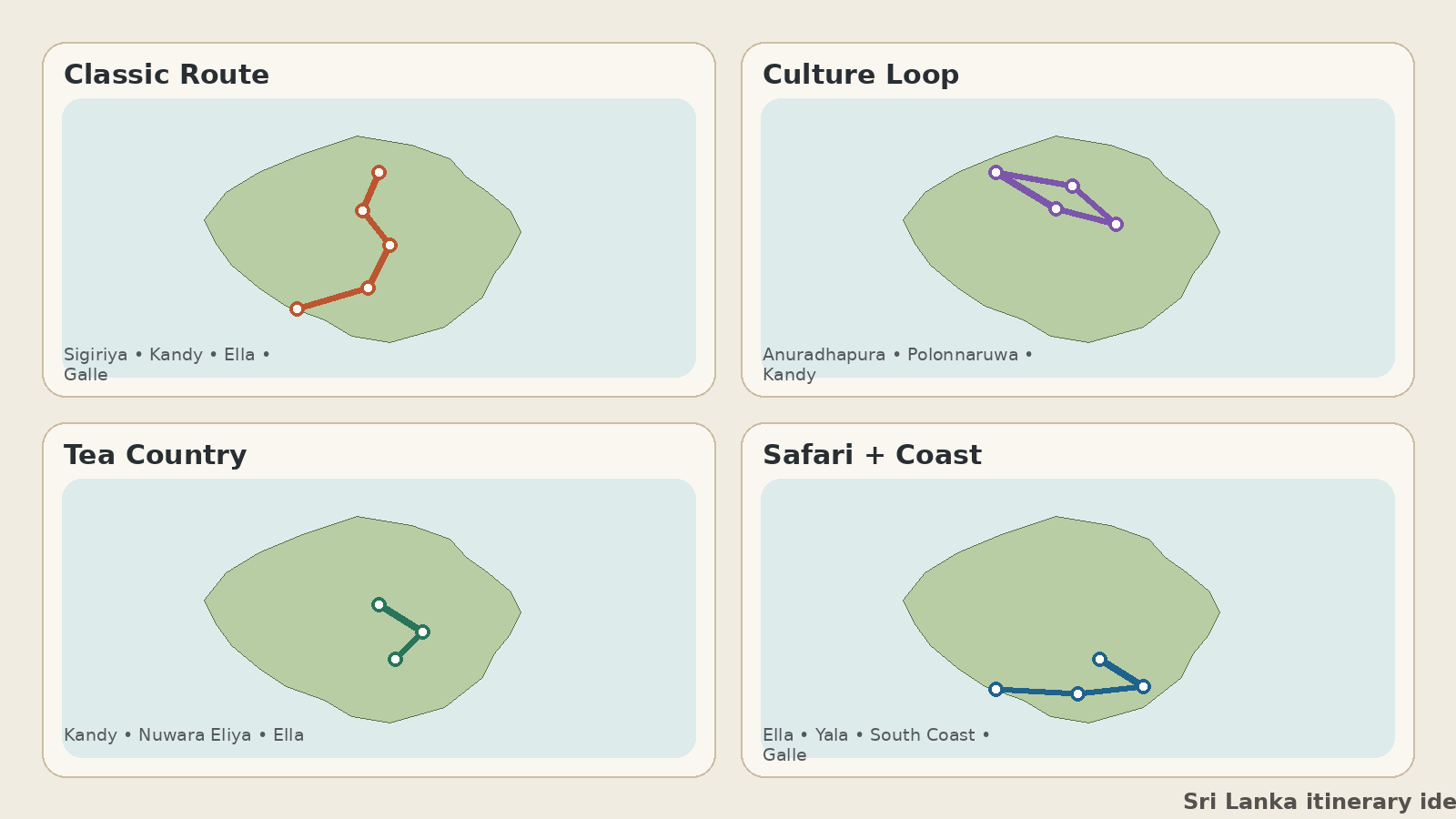
Most travellers do not visit Sri Lanka for only one zone. They want some mixture of culture, hills, and coast, or a route that blends wildlife with a few softer days. This is where region timing becomes a route-building exercise rather than a pure weather question.
A few useful patterns:
- Winter route: west or south coast + Cultural Triangle + hill country often works well
- Summer route: east coast + Cultural Triangle can make more sense than pushing toward the south
- Short trip: choose one coast, not two, and let the rest of the route support it
- Wildlife-led trip: build around the park timing, then add only the regions that sit comfortably around it
This is also where fewer bases can improve the weather experience. When the route is cleaner, you give yourself more flexibility to enjoy a good window instead of constantly moving.
What to do when your dates are fixed
Many travellers do not have the luxury of choosing dates first and route second. School holidays, annual leave, and flight prices often fix the calendar before anything else. That is normal. It does not make the trip harder — it just means the route should respond to the dates honestly.
If the dates are fixed, start by deciding which one or two experiences matter most. Is it beach time? Tea country? Wildlife? Temple and heritage sites? Once that is clear, you can give those priorities the better part of the map and let the rest of the route support them.
This is usually better than trying to keep every popular region in play. Sri Lanka rewards trips that choose clearly.
The fixed-date advantage
Final thoughts
The best time to visit Sri Lanka is rarely one magic month that suits the entire island. It is usually the period when the parts of the island you care about most are likely to work well together.
Once you think in regions instead of one island-wide answer, the planning gets calmer. You choose the coast that fits the season better, add the hills if they help the route, and bring in culture or wildlife without forcing the trip into a weather puzzle.
That is the version of seasonal planning that usually leads to a better Sri Lanka trip: not perfect everywhere, but well matched to the traveller and the route.

