

A lot of Sri Lanka itineraries become tiring because they treat every major stop the same. One night here, one night there, keep moving, cover the island. On paper, it looks efficient. In practice, it often flattens the trip.
Kandy, Sigiriya, Ella, and Galle do not all play the same role in a route. Some are better as short cultural bases. Some need a little more breathing room. Some can carry both sightseeing and recovery. Others start to feel thin if you only sleep there once.
The useful question is not how many nights are "standard." It is how many nights let each place do its job in your particular route.
The fast answer: where one night often works and where it often does not
If you want the short version first, here is the general pattern most travellers find comfortable:
- Kandy: often 1 or 2 nights
- Sigiriya / Cultural Triangle: usually 2 nights if it matters to the trip
- Ella: usually 2 nights, sometimes 3 if hiking and train timing matter
- Galle / south coast: usually 2 or more nights, especially if beach time is part of the point
That does not mean shorter or longer stays are wrong. It means those are the ranges where the place usually starts to feel properly useful instead of rushed or underused.
The key principle
Kandy: often one night is workable, two nights can feel kinder
Kandy sits in an interesting position. For many routes, it acts as a transition stop between the Cultural Triangle and the hill country, or as a short cultural city in its own right. That is why one night can absolutely work there, especially if you mainly want the Temple of the Tooth, botanical gardens, or a softer city break before moving on.
But Kandy can also benefit from two nights if you dislike fast hotel changes, want a slower arrival after a longer drive, or prefer to keep one evening and one full day without packing again immediately.
- One night works when: Kandy is a bridge stop and the route already has stronger priority bases elsewhere
- Two nights help when: you want culture without pressure, or you need the route to breathe a little before the hills
Kandy rarely needs a long stay for first-time travellers, but it often deserves more thought than a default overnight label.
Sigiriya: this is the one that most often deserves two nights
Sigiriya and the wider Cultural Triangle are where one-night planning often starts to break. People imagine they can arrive, climb Sigiriya, see Dambulla, maybe fit Polonnaruwa, and still keep the route relaxed. Usually, that is exactly where the trip starts to feel compressed.
Two nights in the area usually works much better because it lets the region act like a true base instead of a box-ticking stop. You can separate major sights, start early when it helps, and still have a little room around the heat.
- One night works when: you only want one major sight and the area is not a main priority
- Two nights help when: Sigiriya is a real highlight, or you want Dambulla, village experiences, Polonnaruwa, or safari add-ons nearby
Why this matters
Ella: one night is usually too thin unless the route is very tight
Ella has a different rhythm. People go there for the mood as much as the checklist: tea-country scenery, train travel, little cafés, walks, viewpoints, and the emotional shift into the hills. Because of that, one night often feels undercooked.
If the train ride is part of the plan, or if Little Adam's Peak, Nine Arch Bridge, and a slower hill-country feel matter to you, two nights is usually the more satisfying minimum. Three can be even better if Ella is one of the emotional anchors of the trip.
- One night works when: the route is short and Ella is more of a scenic pause than a proper base
- Two nights help when: you want the train, one active day, and one calmer arrival or departure rhythm
- Three nights help when: you want hiking, downtime, and less pressure around the hill-country section
Galle and the south coast: two nights is usually the starting point, not the luxury version
Galle is sometimes treated like a quick historic stop, but in many routes it also represents the beginning of the softer coast part of the journey. That changes the night count completely.
If you only want to walk the fort and move on, one night can technically work. But if the south coast is meant to be where the trip exhales — beaches, cafés, slower mornings, a sunset walk, maybe a whale-watching or turtle-hatchery add-on nearby — then two nights is often the actual minimum that lets it feel like a coast stay.
- One night works when: Galle is mainly a route marker on the way elsewhere
- Two nights help when: you want the fort plus a genuine coast rhythm
- Three or more nights help when: the beach section is one of your main priorities
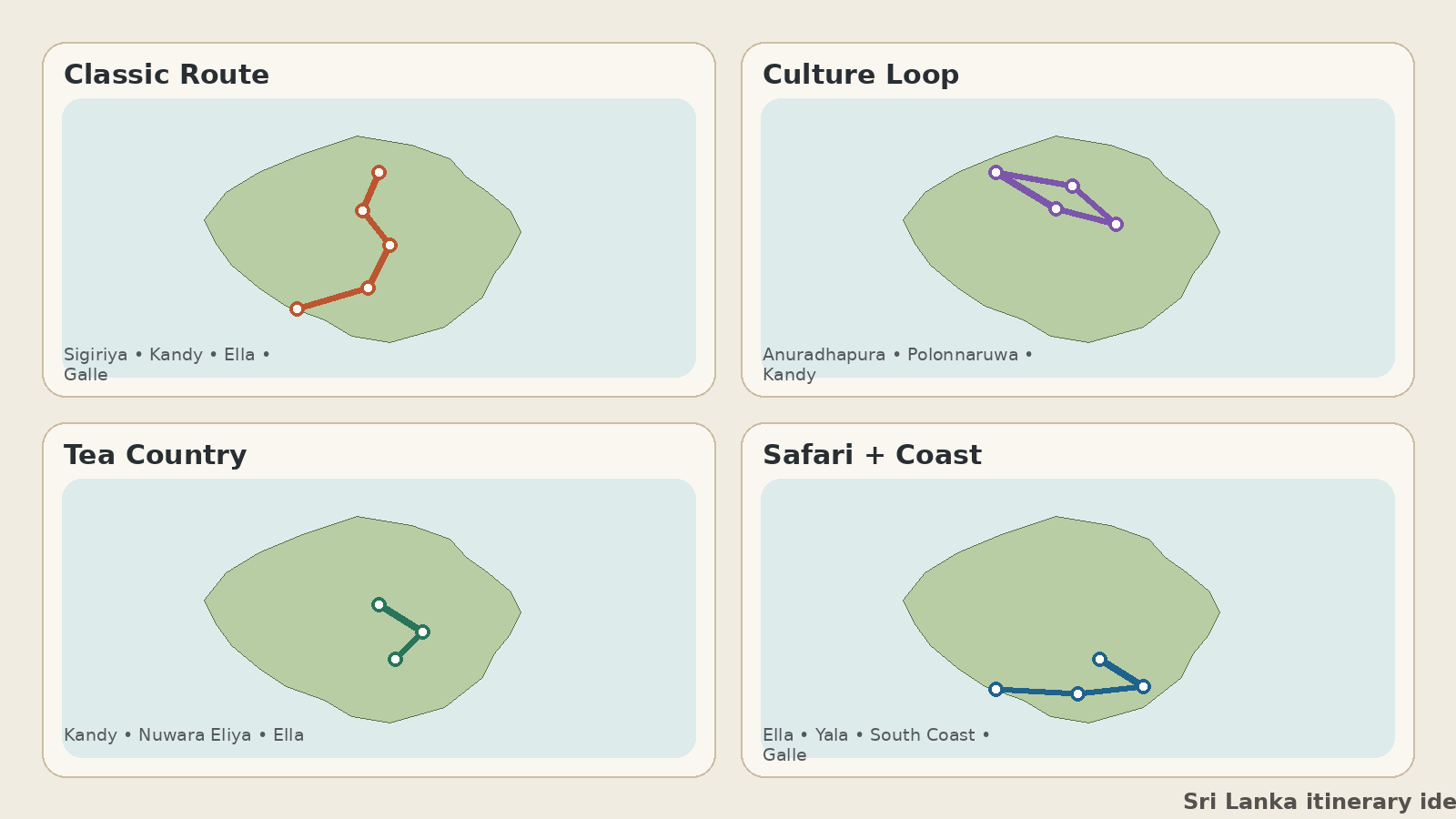
When one-night stays work well
One-night stays are not automatically bad. They often work well when the place has a clear job and the route around it stays balanced. A one-night stop can be useful as a bridge, a scenic break, or a short cultural anchor between bigger bases.
They usually work best when:
- The drive in is not already too demanding
- You are not trying to do multiple major sights the next day before moving again
- The traveller is comfortable with a slightly quicker rhythm
- The place is not supposed to provide both recovery and sightseeing at once
The problem is not the existence of one-night stays. It is when too many of them stack together and the whole route becomes one long process of arrival and departure.
When extra nights protect the whole trip
Adding a second night can sometimes look like you are losing ground. In reality, it often improves the value of the place you are already paying to reach. It also protects the sections before and after it.
An extra night is especially valuable when:
- The place involves early starts, climbs, or train timing
- The transfer into it is already substantial
- You want the stop to carry both activity and recovery
- The route has children, older travellers, or mixed energy levels
This is why a calmer itinerary often looks slightly less "impressive" on paper but feels noticeably better when travelled.
Final thoughts
Kandy, Sigiriya, Ella, and Galle all belong in plenty of good Sri Lanka routes. What changes the quality of the trip is not just whether they are included, but whether they get the right amount of time.
Kandy can often work in one or two nights. Sigiriya usually gets better with two. Ella rarely feels complete with only one. Galle and the south coast often need at least two if the route is meant to soften there.
When in doubt, choose the night split that protects the feel of the place — not just the total number of places on the list.

