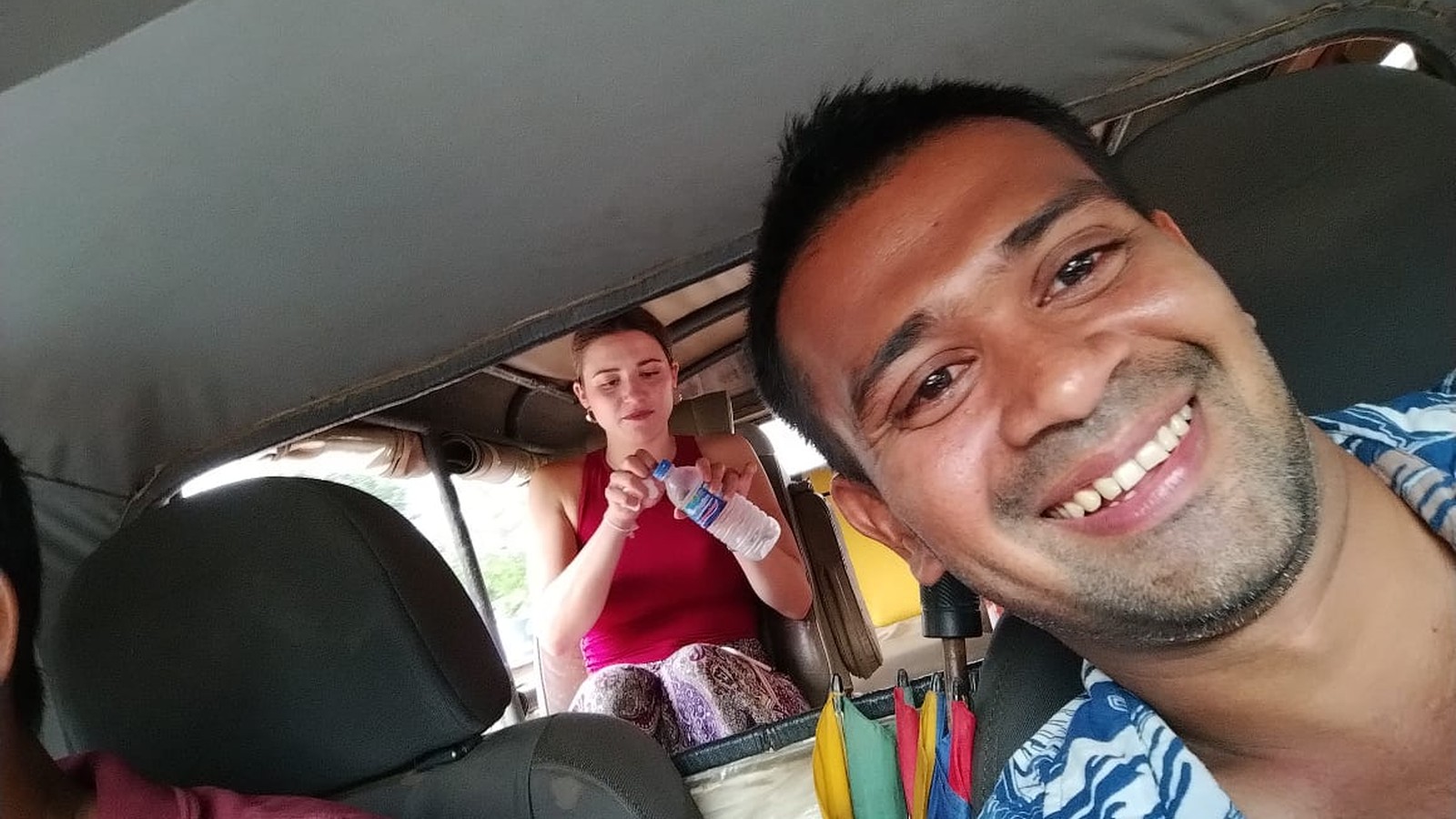
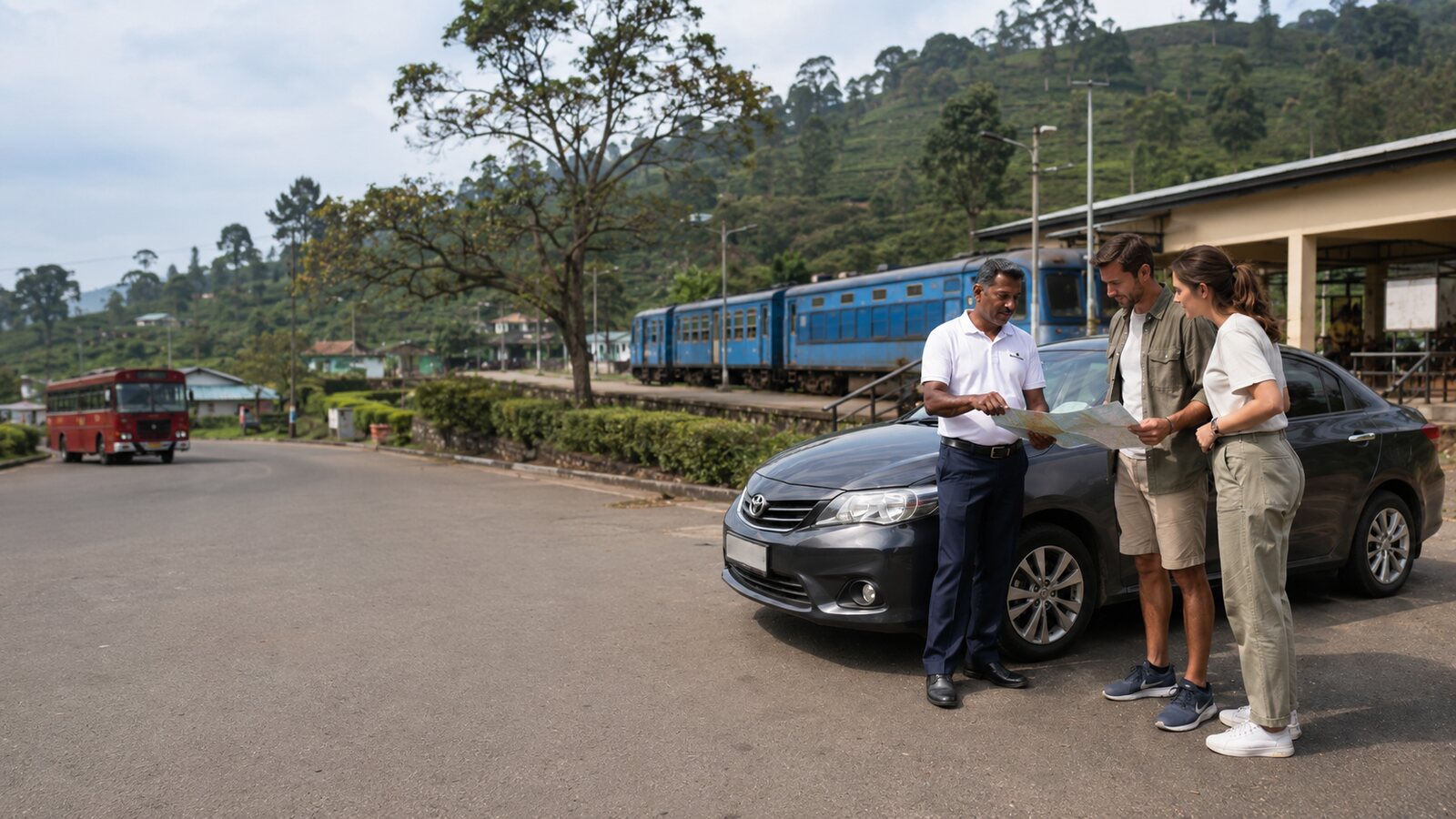
Many Sri Lanka trips work best as a mix, not a single rule. A private driver can make a multi-day route calm and efficient. A train can be a beautiful experience in the hill country. A taxi can be enough for one simple transfer. A bus can be cheap, lively, and tiring at the same time.
The right answer depends less on what looks adventurous online and more on what your actual holiday needs: luggage space, reliable timing, hotel-to-hotel travel, comfort after flights, and the ability to stop when the road day asks for it.
A private driver is best when the route has several moving parts
A private driver makes the most sense when your Sri Lanka trip is not just one transfer, but a sequence: airport to Cultural Triangle, then Kandy, then hill country, then safari or coast, then back toward the airport.
In that kind of route, the value is not only the vehicle. It is the continuity. Your luggage stays with the same car, start times can be adjusted, stops can be added or removed sensibly, and the driver understands the next day rather than treating each ride as a separate booking.
- Best for 5–14 day routes with several hotel changes
- Helpful with luggage, families, older travellers, or mixed pace
- Good when you want train, safari, and hotel timing coordinated
- Less ideal if you only need one short city ride
Taxis and ride apps are fine for simple point-to-point needs
For short rides, city transfers, or a one-off movement between nearby places, a taxi or ride app can be enough. It can also be useful if you are already based somewhere for several nights and only need local transport occasionally.
The weakness appears when you try to stitch a whole island route together from separate rides. Availability, vehicle size, luggage comfort, language, route knowledge, and timing can vary from one ride to the next. That is manageable for some travellers, but tiring for others.
A taxi is a good tool. It is not always a good route system.
The train is worth doing for the experience, not for every journey
Sri Lanka’s railways are part of the romance of the island, especially through the hill country. The Kandy, Nanu Oya, Haputale, and Ella section is famous for good reason: tea slopes, valleys, slower rhythm, and that feeling of seeing the landscape from a different angle.
But the train is not automatically the easiest way to travel. Seats can be limited, schedules can change, luggage can be awkward, and stations may not sit conveniently next to your hotel. The train works best when you treat it as an experience built into the route, not as the answer to every transfer.
A strong mixed-route option
Buses are cheap, but they ask more from the traveller
Buses are part of daily Sri Lankan life and can be a memorable way to understand the country. They are also inexpensive compared with private transport. But for many international travellers, especially with luggage, buses become more demanding than expected.
They can be crowded, hot, fast-moving, and difficult to manage with large bags or children. They also usually require more patience around connections and local knowledge. For backpackers with time and light luggage, that may be acceptable. For a short holiday with hotels booked, it can become a lot of hidden work.
How to choose without overthinking it
A simple rule helps. Use the transport style that protects the purpose of that part of the trip. If the purpose is to experience the hill-country rail journey, use the train. If the purpose is to arrive at the next hotel calmly with luggage and timing under control, use a driver or transfer. If the purpose is a short local hop, a taxi may be enough.
- Use a private driver for linked multi-day routes
- Use a pre-booked transfer for airport and intercity point-to-point moves
- Use the train where the journey itself is the attraction
- Use taxis for short, simple local movements
- Use buses if budget and local experience matter more than comfort and timing
Final thought: the best transport plan is often mixed
You do not have to choose one identity for the whole trip. A well-built Sri Lanka route may use a private driver for the island loop, the train for one scenic segment, and a clean airport transfer at the beginning or end.
That kind of mixed plan often gives travellers the best of both worlds: enough freedom to feel personal, enough structure to avoid stress, and enough local experience without turning every movement into a project.